BE Joins the S&P 500: Priced In, or More Room to Run?
Assessing remaining catalyst edge and entry risk/reward after substantial pre-announcement appreciation
Attractive Only on Pullback
S&P 500 inclusion is a genuine positive catalyst for Bloom Energy, but much of the near-term index trade appears to have been aggressively anticipated prior to the official announcement. Historical evidence suggests that additions with strong pre-announcement appreciation show materially weaker post-announcement continuation. The current risk/reward favors patience over chasing the inclusion gap.
1. What Happened: The Event and Current Market Setup
On Friday, September 4, 2026, after the market close, S&P Dow Jones Indices officially announced that Bloom Energy Corp. (NYSE: BE) will join the S&P 500 benchmark, replacing Molson Coors Beverage Co. (NYSE: TAP). The change takes effect prior to the market open on Monday, September 21, 2026, with institutional index-tracking funds executing their rebalancing trades at the market close on Friday, September 18, 2026.
Crucially, Bloom Energy did not enter this announcement from a neutral price base. The stock rallied aggressively during the sessions immediately preceding the announcement and jumped further in after-hours trading to approximately $266.50 (an additional gain of roughly +5.39%). The catalyst is genuine, but the critical question is how much of this future demand has already been absorbed into the current price.
2. The Three Pieces of Evidence That Matter
Evaluating whether any post-announcement edge remains requires empirical market observations and conditional historical base rates rather than sentiment.
Evidence 1: Bloom Energy Was Substantially Front-Run Prior to Confirmation
Market data reveals intense pre-positioning. Over the 5 trading days leading into the Friday close (August 28 to September 4), BE advanced from $210.77 to $252.87, representing a gain of +19.97% against a flat S&P 500 (+0.11%), creating a 5-day excess return of +19.86%. Including the after-hours reaction to roughly $266.50, the cumulative 5-day appreciation reached +26.44%.
Volume data confirms this observation. In the 5 sessions prior to the official release, BE traded 67.7 million shares (over $17 billion in turnover). When compared to our baseline passive index demand estimate of approximately 33.7 million shares, trading turnover in the week prior to the release was more than double the anticipated passive rebalancing demand. This heavy turnover suggests that substantial speculative positioning had already occurred before public confirmation.
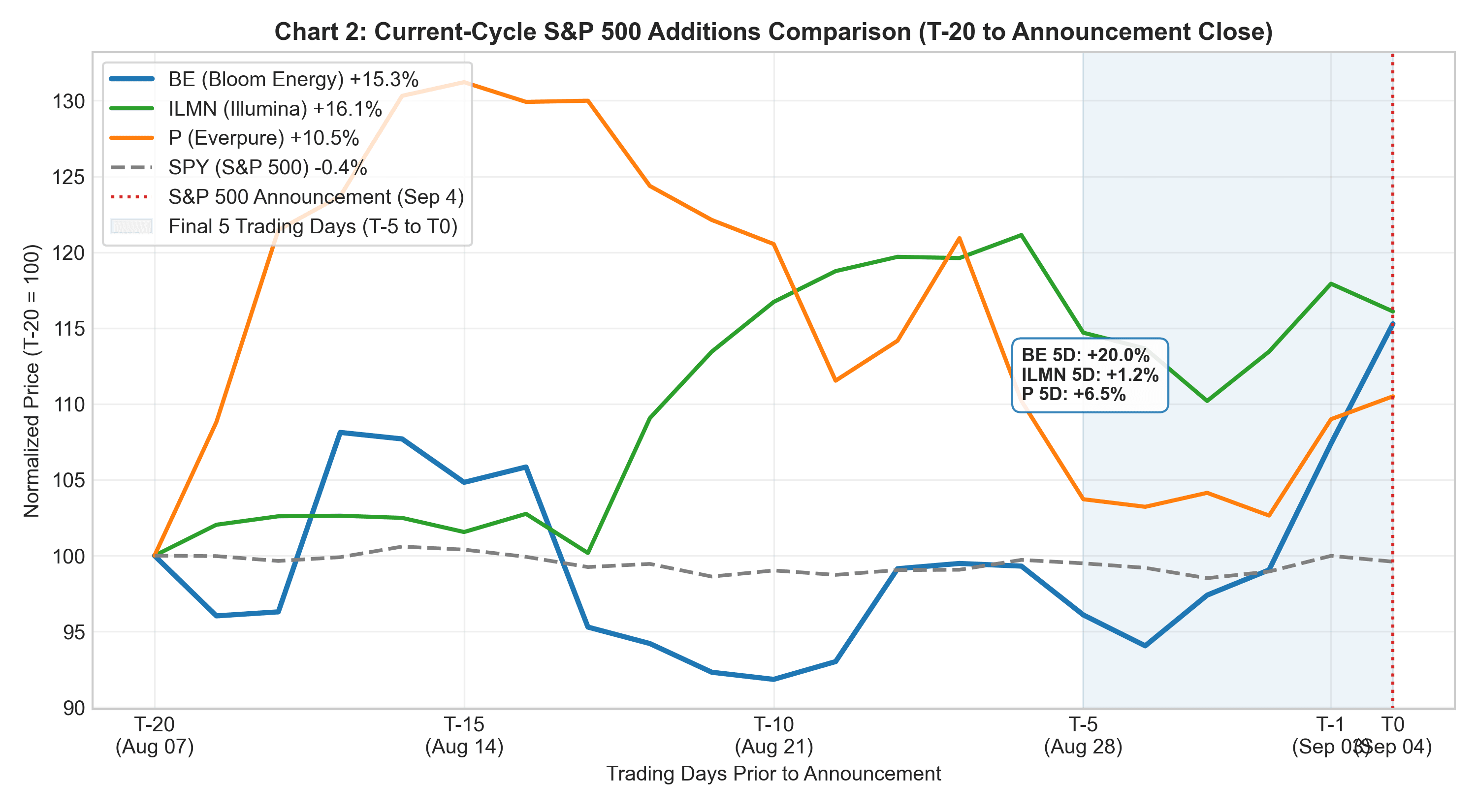
Same-Cycle S&P 500 Additions Comparison (T-20 to Announcement Close): Bloom Energy decoupled sharply from same-cycle additions Illumina and Everpure in the 5 sessions prior to confirmation, reflecting intense speculative front-running.
Evidence 2: Same-Cycle Additions Reveal BE's Outlier Speculation
Illumina (ILMN) and Everpure (P, formerly Pure Storage) were announced alongside Bloom Energy in the same quarterly rebalance. Their price action presents a sharp contrast: ILMN gained only +1.22% over the prior 5 sessions and fell -1.55% during regular Friday hours; Everpure posted a measured +6.54% 5-day gain and rose +1.39% on Friday.
In after-hours trading, both ILMN and Everpure posted measured gains between +1.7% and +2.1%. In contrast, Bloom Energy surged +5.39% after hours on top of a +7.35% regular session gain. This contrast demonstrates that BE was not simply absorbing a mechanical index event; its inclusion was superimposed on high momentum, options gamma activity, and crowded short-term anticipation.
Evidence 3: Historical Front-Run Additions Exhibited Substantially Weaker Continuation
Investors often rely on broad historical averages, assuming that S&P additions consistently produce positive post-announcement drift. However, unconditional averages can be misleading. The relevant question is conditional: what historically happened to additions that were already aggressively front-run prior to confirmation?
Market Glance evaluated 63 validated S&P 500 additions across 2015 to 2024. Across the full sample, the median return from announcement close to the rebalance close was +2.12% with a 68.3% win rate. However, for the subgroup of additions with a 5-day pre-announcement excess return of 5% or greater (10 cases), the median announcement-to-rebalance return dropped to -0.04% (median excess return of -1.74%), and the win rate fell to 50.0%. Statistical correlation between pre-announcement excess return and subsequent rebalance return was negative (r = -0.210).
Notable historical analogs reinforce this base rate: Penn National (PENN) in March 2021 rallied sharply into announcement, then declined -10.04% into rebalance and fell -21.35% over the subsequent 20 days; Generac (GNRC), a peer in on-site power generation, declined -7.19% into its rebalance. When an index catalyst is aggressively pre-traded, the mechanical closing-auction volume frequently serves as exit liquidity for pre-positioned capital rather than fueling a new leg higher.
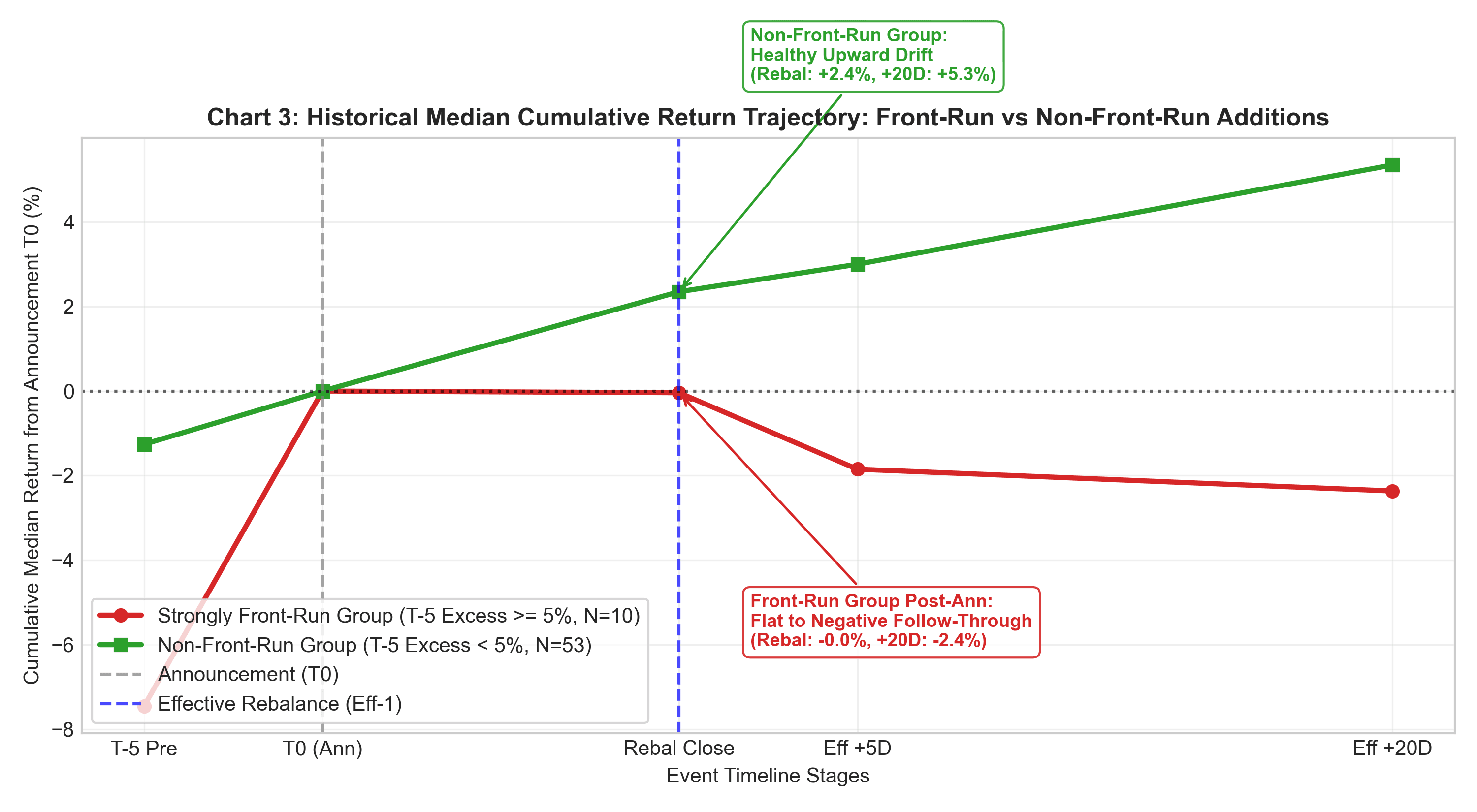
Historical Median Return Trajectory: Front-Run vs. Non-Front-Run Additions: Across 63 historical additions, stocks front-run by 5% or more before announcement (red line) produced a median announcement-to-rebalance return of -0.04%, followed by negative drift after inclusion.
3. Why This Is Not a Bearish Call on Bloom Energy
It is essential to distinguish between a catalyst being priced in and a bearish structural view. Observing that an index event has been heavily front-run does not mean Bloom Energy's business narrative is broken.
Bloom Energy possesses a compelling secular tailwind: AI data center power demand faces 4 to 7 year utility interconnection waitlists across major grids, whereas Bloom's Solid Oxide Fuel Cells (SOFC) offer fast-deploying, behind-the-meter baseload power. On September 3, Bloom introduced its 'Power Connect' architecture, designed to reduce on-site installation time by over 40%. Supported by latest quarterly revenue growth of +165.5% YoY and gross margins expanding to 31.7%, the operational story remains vibrant.
This is precisely why our assessment is 'Attractive Only on Pullback' rather than an outright sell. For investors aligned with the data center power thesis, waiting for event-driven speculative positioning to clear and allowing prices to consolidate offers a substantially superior risk/reward balance compared to chasing the gap-up.
4. What We Are Watching Next
1. Post-Announcement Gap Retention
Observe whether Tuesday trading holds the after-hours gap or encounters immediate profit-taking from pre-positioned accounts. Early weakness would confirm event-exhaustion pressure.
2. Rebalance Window Price and Volume Action
Track price behavior into the Friday, September 18 closing auction, when passive index funds execute. Heavily front-run additions often stall or drift lower into the actual rebalance deadline.
3. Consolidation Versus Continued Extension
With BE extended more than 15% above its 20-day SMA and carrying an Average True Range near $16, observing whether the stock can build a stable base of consolidation is far preferable to chasing vertical extension.
Research note: Historical analysis covers 63 validated S&P 500 additions between 2015 and 2024. All returns are based on completed regular-session closing data. Historical base rates and analog cases serve as probabilistic context rather than a deterministic forecast of future price behavior.
Sources & References
- S&P Dow Jones Indices Official Press Release: Quarterly rebalance press release issued post-close on September 4, 2026 via PR Newswire and S&P Global.
- Bloom Energy Corporate Disclosures & SEC Filings: Q2 2026 Form 10-Q filing, and the official Power Connect deployment architecture announcement on September 3, 2026.
- Public Market Pricing & Volume Feeds: Market historical daily OHLCV data covering 2015–2026 S&P 500 additions and SPY benchmark from verified financial market data feeds.